It’s a scorching afternoon, the house is heating up, and your air conditioner is running. But the air coming out feels warm, or barely cool. Most people reach for the phone straight away. Sometimes that’s the right move. Often, though, the cause is simple, and a few safe checks can save you a callout. Knowing when to fix it yourself and when to call an electrician Yanchep homeowners trust makes a real difference.
This guide walks you through the checks we suggest for an air conditioner blowing warm air Yanchep homes deal with every summer. It explains what each check tells you, what you can safely do yourself, and which signs mean you should stop and get help.
We’ve written it from what we see on real service calls. Many “broken” systems turn out to have a wrong setting, a clogged filter or a tripped circuit. A good residential electrician Yanchep families rely on will always rule these out first, and so can you.
Yanchep’s coastal conditions also play a part. Sand, salt air and strong summer heat put extra strain on outdoor units. That’s why local electrical contractors Yanchep residents call often find faults that start outside the house, not inside it.
A split or ducted system doesn’t make cold air. It moves heat from inside your home to the outdoor unit, where a fan blows it away. For this to work, the indoor fan, outdoor fan, compressor and refrigerant must all work together. If any one of them stops, the indoor unit may still blow air, but that air won’t be cool.
That’s why warm air is a symptom, not a diagnosis. The cause can be as simple as a remote setting, or as serious as a failed compressor. The checks below run from easiest to most technical, so you rule out the simple causes first.
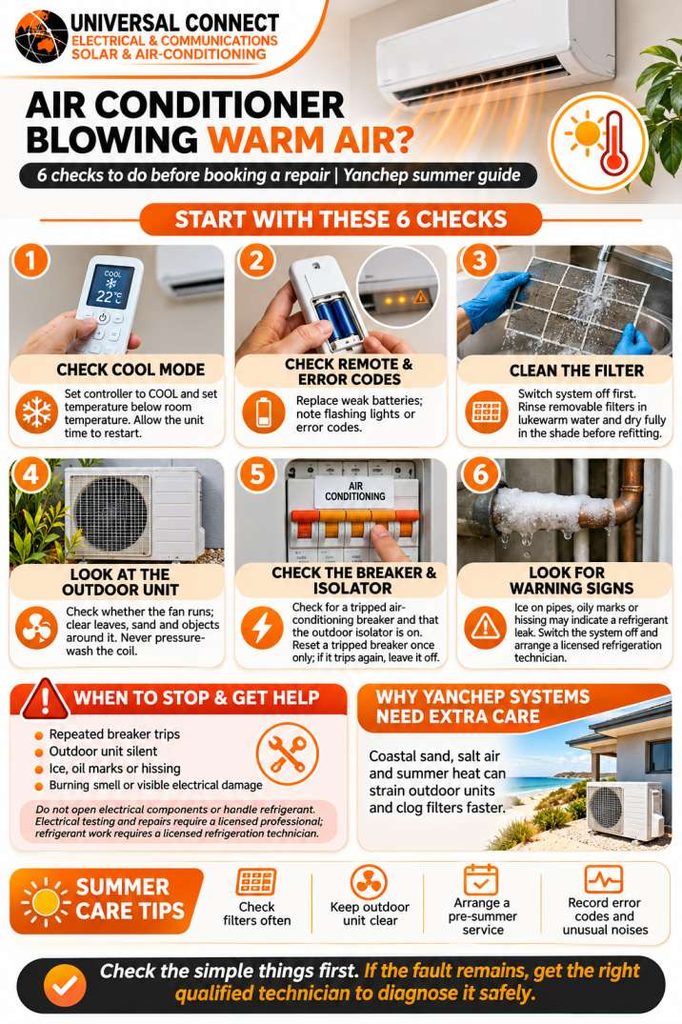
This sounds obvious, but it’s the most common cause we find. Check that the remote or wall controller shows cool mode, not fan, dry, heat or auto. A child or visitor may have pressed the mode button. Fan mode only moves room air, so it feels warm on a hot day. Also check the set temperature. If it’s set above the room temperature, the system has no reason to cool.
After changing the mode, give the system a short while. Many units have a built-in delay that protects the compressor before it starts again.
Weak batteries can stop the remote sending the right signal, even when the screen looks normal. Swap in fresh batteries and try again. Next, look at the indoor unit for flashing lights or an error code. Write the code down and check your owner’s manual. An error code tells a technician where to start, which saves time on site.
A dirty filter blocks airflow across the indoor coil. With too little air moving, the coil can get too cold and even ice up, and cooling drops sharply. Turn the system off at the isolator or circuit breaker first. Then open the front panel, slide out the filters and rinse them in lukewarm water. Let them dry fully in the shade before refitting.
In coastal homes, we often see filters packed with fine sand and dust after only part of a summer. Regular cleaning is the cheapest maintenance you can do.
Go outside while the system is running in cool mode. Is the outdoor fan spinning? Can you hear the unit running? If the indoor unit blows air but the outdoor unit sits silent, the system can’t remove heat. This usually points to a power, control or component fault rather than a setting.
Also check around the unit. Leaves, sand, plants, bins or stored items can block airflow. Keep at least a clear space around the sides and front. In Yanchep, salt and sand build up on the outdoor coil fins. With the power isolated, you can gently remove loose debris, but never use a pressure washer on the coil.
Many systems use a separate circuit for the outdoor unit. If that circuit trips, the indoor fan may still run while the outdoor unit stays off. Check your switchboard for a tripped breaker labelled air conditioning. Also check the isolator switch beside the outdoor unit is on.
You can reset a tripped breaker once. If it trips again, leave it off. Repeated tripping means an electrical fault, and resetting it again can damage the system or create a safety risk.
Check the copper pipes running to the outdoor unit. Ice on the pipes, oily marks on joints, or a hissing sound can point to a refrigerant leak. Low refrigerant makes the system run without cooling properly. This is not a DIY fix. Refrigerant work must be done by a licensed refrigeration technician, so switch the system off and arrange an inspection.
| Check | What You’ll Notice | What It Usually Means |
|---|---|---|
| Mode and temperature | Fan, dry or heat mode showing | Setting issue, easy to fix |
| Remote and error code | Flashing lights or code on screen | Fault the system has detected |
| Filter | Grey, dusty or clogged filter | Restricted airflow, possible coil icing |
| Outdoor unit | Outdoor fan not spinning or unit silent | Power, control or component fault |
| Switchboard | Tripped air conditioning circuit | Electrical fault if it trips again |
| Pipes | Ice, oil marks or hissing | Possible refrigerant leak |
When the simple checks don’t fix the problem, the cause is often electrical. A failed run capacitor can stop the outdoor fan or compressor from starting. A worn contactor may stop power reaching the outdoor unit. Loose or corroded terminals, damaged cabling and faulty isolators are also common, especially on units exposed to coastal air.
These parts carry dangerous voltage, and some hold a charge even after power is off. Only a licensed professional should test or replace them. An experienced electrician Yanchep households call can test the circuit, isolator, capacitor and contactor safely, then confirm whether the system needs electrical repair or a refrigeration technician.
Here’s a typical example. A family’s ducted system blew warm air on a hot afternoon. The indoor fan ran fine, but the outdoor unit hummed without starting. Testing showed a failed capacitor, made worse by corrosion on the terminals. Once replaced and the terminals cleaned, the system cooled normally again.
Warm air doesn’t always mean a costly repair. Start with the mode, settings, filters, outdoor unit and switchboard. If those checks don’t solve it, a qualified electrician Yanchep homeowners rely on can safely test the electrical parts.
Use this guide whenever you notice an air conditioner blowing warm air Yanchep summers can make worse. The right checks, done in order, save time and help you explain the problem clearly.
If the system keeps tripping, the outdoor unit won’t start, or you spot ice or oil on the pipes, switch it off and book an inspection with a residential electrician Yanchep team you can trust.
At Universal Connect Pty Ltd, we test circuits, isolators and outdoor unit components, and we tell you honestly what we find. As local electrical contractors Yanchep families know, we’ll also let you know when a job needs a licensed refrigeration technician instead.
The most common causes are a wrong setting, a dirty filter or an outdoor unit that isn’t running. Check that the system is in cool mode and the set temperature is below room temperature. Then clean the filters and confirm the outdoor fan is spinning. If the indoor unit runs but the outdoor unit stays silent, a tripped circuit, failed capacitor or contactor fault is likely, and an electrician Yanchep residents trust should test it safely.
You can reset a tripped breaker once, as long as you see no burning smell, scorch marks or damage at the switchboard. If it trips again, leave it off. Repeated tripping means the circuit is protecting you from a real fault, such as damaged wiring, a failing compressor or moisture in a connection. Forcing it back on can make the fault worse. A residential electrician Yanchep households rely on can find the cause and repair it properly.
In coastal suburbs, filters clog faster because of fine sand, dust and salt in the air. During busy summer use, check them often and clean them whenever they look grey or dusty. Always switch the system off first, rinse the filters in lukewarm water and let them dry fully in the shade. Clean filters keep airflow strong, help the system cool evenly and reduce strain on the fan and compressor.
Electricians handle the electrical side, such as circuits, isolators, capacitors, contactors and wiring. Refrigerant work, including finding leaks and regassing, must be done by a licensed refrigeration technician. That’s why a good diagnosis matters. Local electrical contractors Yanchep homeowners trust will test the electrical parts first. If those are fine and signs point to low refrigerant, such as ice on pipes or hissing, they’ll tell you plainly that the system needs a refrigeration specialist.
Give as much detail as you can. Note the brand and system type, any error code on the indoor unit, and whether the outdoor fan runs. Mention if the breaker tripped, if you heard unusual noises, or if you saw ice or oil on the pipes. Tell them which checks you’ve already done. This helps them bring the right parts and diagnose the fault faster, which reduces disruption on a hot day.