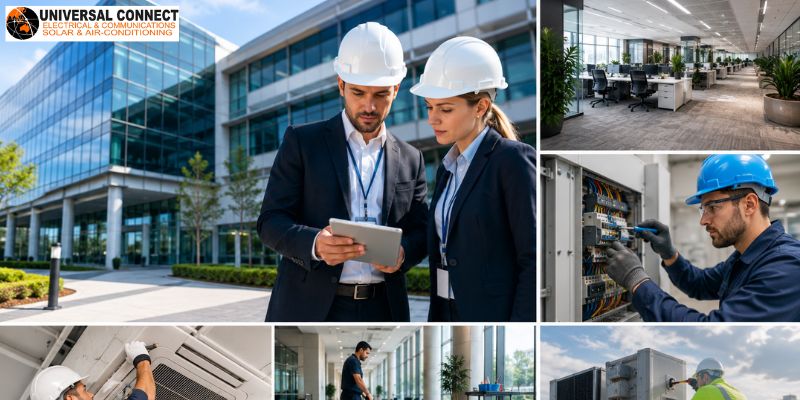
Commercial properties are getting more complex than ever. The most advanced offices, retail centers, healthcare facilities, warehouses, and mixed-use developments depend on a variety of tools that enable them to remain safe and efficient. However, there is a lack of awareness concerning all the services that professional facility managers provide.
Preventive maintenance, energy management, safety at the workplace, and regulatory compliance – there are many things that make facilities management an essential aspect of any commercial property management process. As per IFMA, facilities management costs may constitute about 20-30 percent of a business’s total spending. So, proper management of such costs should be taken seriously. Facilities management services are explained in this blog.
Facilities management (FM) is the process of managing buildings, systems, people, and services to maximize their effectiveness and compliance.
Facility management in Australia includes several components, such as operations management, asset management, sustainability, risk management, and other aspects.
The main idea behind facilities management in Australia is maximizing efficiency and minimizing costs.
Modern commercial facilities have been increasingly challenged with various problems:
According to a report from the Australian Bureau of Statistics (ABS), commercial facilities consume a considerable share of Australia’s total energy consumption. Effective FM allows reducing energy consumption by up to 10-30% thanks to careful planning and monitoring.
Property owners stand to gain immensely from small yet effective operational improvements.
Facilities services offered to commercial facilities usually encompass multiple areas of expertise.
Among all the tasks within facility management, maintenance may be considered the most apparent one.
In lieu of fixing issues after they occur, professional FMs rely on comprehensive maintenance planning.
| Maintenance Area | Examples |
| HVAC Systems | Air conditioning inspections, filter replacement |
| Electrical Systems | Testing, repairs, emergency lighting checks |
| Plumbing | Leak detection, pipe maintenance |
| Fire Systems | Alarm testing, sprinkler inspections |
| Elevators | Routine servicing and certification |
| Building Fabric | Roof inspections, exterior repairs |
Compliance management forms one of the crucial yet least understood elements of facilities management services explained.
Australian commercial buildings have to adhere to many regulations with regard to:
What happens if there’s a failure to conduct a mandatory inspection of a fire system in a commercial building in Sydney? Apart from possible fines, the owner will increase their liability risks. Facilities managers help keep all inspections, certifications, and reports up to date.
The physical assets of a commercial building are worth many millions of dollars.
For example:
Facility asset management entails managing them through their entire life cycle.
| Benefit | Impact |
| Budget forecasting | Predict future replacement costs |
| Risk reduction | Prevent unexpected failures |
| Capital planning | Improve investment decisions |
| Asset longevity | Extend equipment lifespan |
Facilities managers can plan their asset management rather than responding to breakdowns.
Energy costs account for one of the biggest operating costs for commercial buildings. According to the Australian Government’s Commercial Building Disclosure Program, energy-efficient buildings tend to have higher rents and occupancy rate.
One Melbourne office building lowered its electricity consumption by 18% using occupancy sensors, LED lights, and HVAC adjustments from its facilities management service. It took only three years for the savings to recover the cost of upgrades.
Cleanliness plays a key role in occupant’s satisfaction and work productivity.
Common facilities management tasks include:
Research conducted by ISSA (International Sanitary Supply Association) shows clean office space improves productivity and absenteeism.
Disruptions may cause serious problems for businesses.
Professional facilities managers assist commercial buildings in preparing for:
Prepared buildings tend to recover faster after disruptions happen.
Many vendors provide services to commercial buildings.
For instance:
Professional facilities managers work with those vendors to make sure that:
Improper vendor management may lead to increased costs and reduced service quality.
Space is one of the most expensive assets in commercial real estate.
Facilities managers analyse how buildings are used and identify opportunities to improve efficiency.
Studies conducted by workplace consultants suggest that many offices operate with average utilization rates below 60%, creating opportunities for significant optimization.
Modern facilities management increasingly relies on technology.
A Brisbane commercial property installed IoT-based monitoring systems that detected abnormal HVAC performance before equipment failure occurred. The early intervention prevented tenant disruption and avoided a costly emergency repair.
Technology enables facilities managers to make data-driven decisions that improve building performance.
Enhancing operational efficiency is one of the main objectives of facilities management. In totality, a business will be more efficient and cost-effective once these aspects are taken care of.
When choosing an FM firm, businesses need to consider the following:
Top-notch FM firms always aim at enhancing the long-term performance of assets.
With an in-depth discussion of facilities management services provided, the realization is evident that facilities management in the contemporary world is much more than merely dealing with dysfunctional facilities and equipment. Facilities management involves strategic considerations such as maintenance management, operations management, compliance, sustainability, workplace services, security, and asset management. Facilities management services explained in easy terms can be a good help for you.
To those organizations that wonder about the concept of what facilities management is in Australia, the solution is quite straightforward in terms of creating productive, compliant, and safe commercial premises through facilities management services.
As commercial facilities become more complex in operation through technological advancements, facilities management would be crucial for property owners and organizations alike in providing a high return on investment.
Facilities management is concerned with coordinating building activities, building maintenance, compliance, workplace services, and asset management for the efficient and safe operation of commercial buildings.
The services that can be provided are: maintenance planning, compliance management, cleaning, security, energy management, vendor coordination, workplace services, and emergency planning.
Facilities management ensures savings, increased efficiency, compliance, increased life span of the asset, and safety for occupants of the property.
Maintenance planning ensures less equipment failure, savings, less down time, and increased life of the building.
The key difference is that property management concentrates on the business side of owning a property whereas facilities management is concerned about the actual physical building.