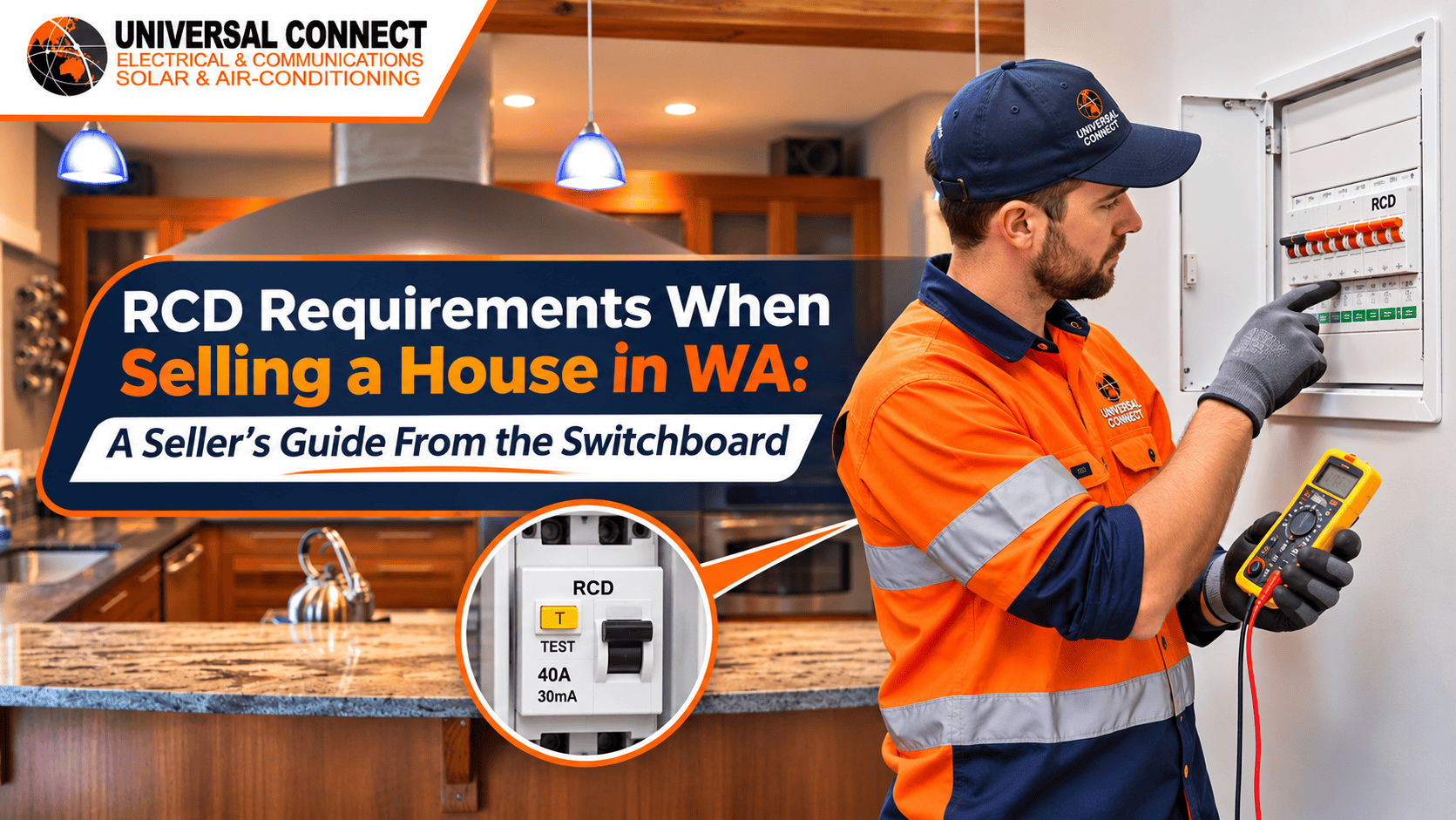
You have booked the agent. The photos look great, and an offer is close. Then the settlement agent asks one simple question: “Does the house have at least two RCDs protecting all power and lighting circuits?” Many sellers stop right there. They don’t know what an RCD looks like, let alone how many their home has.
If you searched for RCD requirements selling house WA, you probably want three answers. What does the law ask for? Does your home pass? And what do you do if it doesn’t? This guide answers all three in plain words.
At Universal Connect Pty Ltd, we work as professional electrical contractors in WA, and pre-sale switchboard checks come up often. We see the same gaps in home after home. Below, we share what we look for, what trips sellers up, and how to fix problems before they slow your sale.
One point matters before anything else. Only a licensed electrical contractor can install or change RCDs in Western Australia. Building and Energy states that unlicensed electrical work, including changes to fixed wiring, is illegal. You can check any contractor’s licence with its online licence search.
A residual current device (RCD) is a safety switch that sits on your main switchboard. It watches the current flowing out to a circuit and the current coming back. If the two don’t match, some electricity is leaking to earth. That leak could be running through a person. The RCD cuts the power in a fraction of a second.
People often confuse RCDs with circuit breakers. A circuit breaker protects the wiring from overload and short circuits. An RCD protects people from electric shock. Your switchboard needs both, but they do different jobs.
WA has taken RCDs seriously for a long time. New homes have needed two RCDs since 2000. In 2009, the State extended the rule to homes being sold or rented. Today, the requirement sits in the Electricity Regulations 1947, and Building and Energy enforces it.
For an existing home offered for sale, rent or hire, the rules are clear. Here is what Building and Energy requires:
The rules for homes on the market did not change when the new Wiring Rules (AS/NZS 3000:2018) arrived for new installations from 1 January 2019. Homes built since then follow the stricter standard. Older homes being sold still need to meet the “two RCDs, all power and lighting” rule.
Smoke alarms carry a separate rule under the Building Regulations 2012. Before a sale, they must:
We usually check RCDs and smoke alarms in the same visit. It saves the seller a second call-out and a second round of waiting.
When professional electrical contractors in WA inspect a home before a sale, we look past the number of switches. Coverage, load and condition matter just as much. This table shows our usual checklist:
| Check | What We Look For | Common Failure |
| Number of RCDs | Two or more on the main switchboard | Only one RCD fitted |
| Circuit coverage | All power and lighting circuits protected | Lights left without RCD protection |
| Load per RCD | No more than three final sub-circuits each | Five or six circuits on one RCD |
| Lighting split | Lighting circuits spread across RCDs | All lights on a single RCD |
| Function test | RCD trips when tested and resets cleanly | Stiff, faulty or non-tripping unit |
| Smoke alarms | Under 10 years, working, hardwired | Expired or battery-only alarms |
| Switchboard condition | Room and safe mounting for new devices | Old fuses, no space, damaged board |
Picture a 1970s brick-and-tile home in Perth’s northern suburbs. The owner spots one safety switch and assumes the house passes. On inspection, that RCD covers the power points only. The lighting circuits have no protection at all. The fix is usually simple: add a second RCD and rebalance the circuits. In most homes this is a short job.
Now picture an older home with rewireable ceramic fuses. The board has no space for modern devices. Here, the house may need a switchboard upgrade before RCDs can go in. That takes more planning. If the board might contain asbestos, extra precautions apply. This is why we tell sellers to book early, not in the last week before settlement.
Most compliance problems don’t come from neglect. They come from simple assumptions. These are the ones we hear most:
After years of pre-sale work, a few habits make the process much smoother for sellers.
Book the check before the listing goes live. You then know your position before buyers ask. It also gives you time to compare quotes if your board needs an upgrade.
Ask for the paperwork. A licensed electrical contractor must give you an Electrical Safety Certificate for notifiable work they complete. Keep a copy with your sale documents. Settlement agents and buyers appreciate clear records.
Test your RCDs every three months. Building and Energy recommends this routine. Press the test button, check that the power cuts, then reset the switch. If it doesn’t trip, call an electrician. A faulty RCD needs replacing straight away.
Mention nuisance tripping. If your RCD trips often, tell your electrician. An old appliance with a small leak can cause it. Splitting circuits across more RCDs often solves the problem.
Combine jobs where you can. Our residential electrical services often cover RCDs, smoke alarms and small repairs in one visit. Fixing a loose power point or a dead light before open homes also helps the home show well.
We keep the process simple and transparent:
We don’t recommend work your home doesn’t need. If your switchboard already complies, we tell you so.
The RCD requirements selling house WA owners face are not complicated once you know them. You need at least two RCDs on the main switchboard. They must protect every power and lighting circuit, with no more than three circuits each. Your smoke alarms also need to be current, working and hardwired.
The smartest move is to check early. A short visit from professional electrical contractors in WA before you list can save you a last-minute scramble at settlement.
Always use a licensed electrical contractor, and keep your certificates with your sale documents. If you’re unsure about your legal duties, Building and Energy and your settlement agent can confirm them.
If you’d like a clear answer on your switchboard, the team at Universal Connect Pty Ltd offers residential electrical services across WA, including pre-sale RCD and smoke alarm checks.
Yes. Under the Electricity Regulations 1947, an owner must have compliant RCDs fitted before transferring ownership of a home. Settlement agents usually ask the seller to confirm this. The home needs at least two RCDs that protect every power point and lighting circuit. If your home falls short, book a licensed electrical contractor before you list. Fixing it early keeps your settlement on track and avoids last-minute pressure from the buyer’s side.
Two is the legal minimum, but many homes need more. Each RCD can protect no more than three final sub-circuits. A large home with eight or nine circuits may need three or four RCDs to comply. Your lighting circuits also need splitting across the RCDs where there are two or more. Professional electrical contractors in WA count the circuits on your board and confirm the right number during a short inspection.
The legal duty to have compliant RCDs sits with the owner before the transfer of ownership. In practice, most sellers pay for the work before settlement. However, your sale contract may set out different terms, and some buyers negotiate this point. Check with your settlement agent or lawyer before you agree to anything. Getting the work done early often makes negotiations simpler, because buyers see one less issue to argue about.
Yes, but an old switchboard often needs attention first. Boards with rewireable ceramic fuses rarely have room for modern RCDs. In those cases, an electrician may recommend a switchboard upgrade so the RCDs can go in safely. Boards that may contain asbestos also need careful handling. These jobs take more planning than a simple RCD install, so we suggest booking a pre-sale check several weeks before your expected settlement date.
Find the test button on each RCD, often marked “T” or “Test”. Press it firmly. The switch should trip and cut power to the circuits it protects. Then reset it. Building and Energy recommends doing this every three months. If the switch doesn’t trip, stays stuck or won’t reset, call an electrician straight away. Remember that a working test button does not confirm full coverage. Only a proper inspection shows which circuits each RCD protects.