
Your business network is only as reliable as the infrastructure supporting it. Slow connections, unstable Wi-Fi, unexplained dropouts and difficulty adding new devices can often be traced back to poorly planned or outdated cabling. Choosing the Right Data Cabling Contractors is therefore not simply about finding someone who can run cables from one point to another. It is about selecting professionals who understand network requirements, building conditions, future capacity and the standards that support dependable connectivity.
Whether you are fitting out a new office, upgrading an existing workplace or expanding into another location, the right contractor can help you build a network that is organised, scalable and easier to maintain.
Modern businesses rely on connectivity for almost everything they do. Cloud applications, VoIP phones, video conferencing, point-of-sale systems, access control, wireless access points, printers, servers and security equipment all depend on a reliable communications infrastructure.
Professional data cabling contractors approach an installation as part of the broader network rather than treating cabling as an isolated construction task. They consider where equipment will be located, how much data traffic the business generates and how the infrastructure may need to change as the business grows.
A small office with ten employees may have very different requirements from a warehouse using barcode scanners, wireless devices and surveillance systems. Similarly, a medical practice, educational facility and professional services office can have different connectivity demands.
A good contractor will ask questions before recommending a solution. They should want to understand your current network, future plans, building layout, equipment and operational requirements.
Quality cabling involves considerably more than installing cable neatly along a wall. The installation should be planned around performance, safety, accessibility and future maintenance.
Depending on the project, a professional installation may involve:
The exact solution depends on the premises and network architecture. A contractor should explain why particular cable types, pathways and termination methods are appropriate rather than simply quoting a package without discussing your requirements.
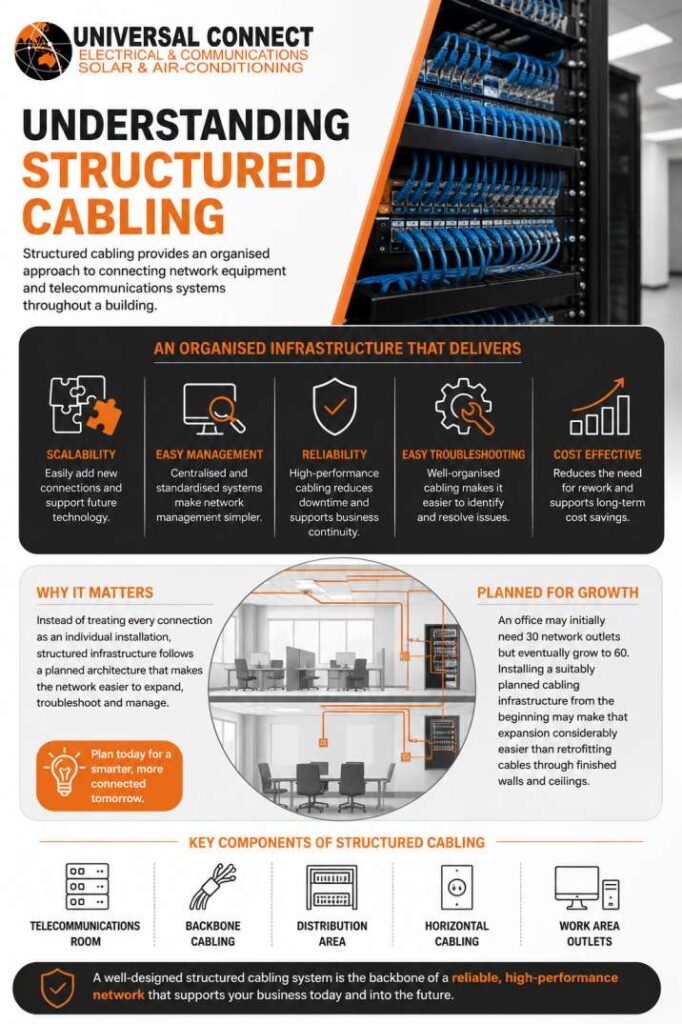
Structured cabling provides an organised approach to connecting network equipment and telecommunications systems throughout a building. Instead of treating every connection as an individual installation, structured infrastructure follows a planned architecture that makes the network easier to expand, troubleshoot and manage.
This becomes particularly valuable when a business expects to add workstations, meeting rooms, wireless access points or other technology in the future. Proper planning can reduce the need for disruptive rework later.
For example, an office may initially need 30 network outlets but eventually grow to 60. Installing a suitably planned cabling infrastructure from the beginning may make that expansion considerably easier than retrofitting cables through finished walls and ceilings.
Experience should be one of your most important selection criteria. However, do not simply ask how many years a company has been operating. Ask whether the contractor has completed projects similar to yours.
A contractor experienced with residential data points may not have the same expertise required for a multi-floor commercial environment. Likewise, a team experienced with office installations may have limited experience working in warehouses, industrial facilities or buildings with complex access requirements.
Ask potential contractors about projects involving similar:
A useful example is a business moving into an occupied office. The cabling work may need to be completed while employees continue working. Experienced contractors understand that installation sequencing, dust control, access coordination and communication with building management can be just as important as the cabling itself.
Ask for examples of comparable work and, where appropriate, references. You are looking for evidence that the contractor has solved practical problems rather than simply completed straightforward installations.
For businesses, commercial data cabling should be planned around operational needs. The cheapest quote may not represent the best value if it excludes testing, documentation, appropriate containment or adequate capacity for future requirements.
A professional contractor should inspect the site before finalising the scope wherever practical. During that assessment, they may consider ceiling spaces, existing cable routes, communications rooms, electrical infrastructure, rack locations and access limitations.
Before accepting a proposal, make sure you understand exactly what is included.
A detailed scope may identify:
This level of detail makes competing quotations easier to compare. It also reduces the likelihood of discovering halfway through an installation that an important component was excluded.
Businesses increasingly use one physical infrastructure to support a range of technologies. This means communication cabling may support traditional voice systems, data networks, wireless infrastructure, security technologies and other connected equipment.
A contractor should therefore consider the wider technology environment instead of designing the installation around today’s equipment alone.
For instance, a business might currently have conventional desk phones but later move to VoIP. Another company may add additional wireless access points as its workforce grows. A warehouse could introduce more network-connected scanners or Internet of Things devices.
Good planning considers these possibilities without unnecessarily installing infrastructure that the business does not need.
Future-proofing does not mean buying the most expensive equipment available. It means making sensible decisions about capacity, accessibility and scalability.
Ask:
A thoughtful contractor can help identify where additional capacity makes sense and where it would simply increase the project cost without a meaningful benefit.
One of the clearest differences between a professional installation and a basic cable installation is what happens after the cables are installed.
A network connection may appear to work while still having performance or termination problems. Proper testing helps verify that installed links meet the required performance criteria.
Ask whether the contractor will test and document the installed cabling. Depending on the project, documentation may include outlet identification, cable routes, rack layouts, test results and other information useful for future maintenance.
Imagine an employee reports that a workstation intermittently loses connectivity. If every cable is clearly labelled and documented, a technician can identify the relevant connection much faster. Without documentation, troubleshooting may involve tracing multiple cables manually.
Testing and records therefore have practical operational value. They can reduce future diagnostic time and provide a useful reference when the network is modified.
Professional network installations need to be completed with appropriate attention to building conditions and workplace safety. Cable pathways should be suitable for the environment, cables should be supported appropriately and installations should not create avoidable hazards.
Ask potential data cabling contractors how they approach cable separation, pathways, penetrations, access equipment and worksite safety.
Contractors should also be familiar with applicable Australian requirements and industry standards relevant to the installation. If your project is in a commercial building, building management or the property owner may also impose additional requirements regarding access, fire-rated penetrations, ceiling spaces and documentation.
You do not need to become a cabling expert yourself. The important point is to choose a contractor who can explain the relevant requirements clearly and demonstrate that they take compliance seriously.
Obtaining multiple quotes is sensible, but comparing only the final dollar figure can lead to poor decisions.
One contractor might quote for cable installation only, while another includes testing, labelling, patch panels, documentation and project coordination. These are not equivalent proposals.
A useful quotation should make it reasonably clear:
If one quote is dramatically cheaper than the others, ask why. The difference may be legitimate, but it deserves investigation before you make a decision.
Choosing a cabling contractor based solely on price is one of the most common mistakes. Another is failing to consider future expansion. Businesses sometimes install exactly what they need today and then discover that additional cabling is difficult or expensive when their requirements change.
Other mistakes include:
These issues may not become obvious immediately. A network can function on day one while still being difficult to maintain or expand later.
Before signing an agreement, speak with the contractor about your actual business objectives rather than simply asking for a price.
A useful conversation might start with: “We are expanding from 25 to 50 employees over the next two years. How would you approach the cabling design?”
The response can reveal a great deal about the contractor’s technical thinking.
Look for professionals who:
You should also be comfortable asking questions that challenge assumptions. A reputable contractor should be able to explain why a particular approach is suitable without using unnecessary technical jargon to pressure you into a decision.
The value of professional cabling becomes particularly apparent over time. A well-designed installation can make it easier to add devices, relocate workstations, troubleshoot connectivity issues and accommodate technology changes.
For example, consider an office that adds a new meeting room. If the original infrastructure included suitable pathways and spare capacity, adding network connections may be relatively straightforward. If the original installation was tightly designed around the first floor plan, the same change could require disruptive and expensive rework.
This is why selecting the Right Data Cabling Contractors should be viewed as an infrastructure decision rather than simply a construction purchase. The quality of planning, installation and documentation can influence how easily your network adapts to future business requirements.
The best cabling decision is not necessarily the cheapest one. It is the decision that balances technical suitability, workmanship, documentation, scalability, safety, project management and long-term business requirements. By asking detailed questions, comparing complete scopes and evaluating relevant experience, you can make a much more informed choice.
The Right Data Cabling Contractors should be able to understand your business environment, explain their recommendations clearly and deliver an organised infrastructure that supports reliable connectivity today while allowing sensible growth tomorrow. Businesses considering a network upgrade can use this checklist when assessing potential providers, including experienced teams such as Universal Connect Pty Ltd, to help ensure their cabling project is approached with proper planning and attention to practical requirements.
Ask about relevant commercial experience, cable types, installation methods, testing, documentation, project timelines, insurance, standards and the scope of work. You should also ask how variations are handled and who will manage the project. The goal is to understand not just what the contractor will install, but how they will plan, deliver and document the entire project.
Yes. Structured cabling can be appropriate for small businesses because it provides an organised foundation that can be expanded as requirements change. The installation should still be proportionate to the business’s needs. A small office does not necessarily require an elaborate infrastructure, but good planning can make future additions easier and reduce unnecessary disruption.
Compare the scope rather than the headline price. Check whether each quotation includes the same cable specification, number of outlets, termination work, patch panels, containment, testing, labelling and documentation. Also consider the contractor’s experience and proposed project management approach. A slightly higher quote can represent better value when it includes important deliverables omitted from a cheaper proposal.
Testing helps verify that installed cable links perform as expected and can identify problems that may not be obvious during normal use. Proper records can also assist with future troubleshooting. If a business experiences intermittent connectivity months after an installation, documented test results and clear cable identification can make the diagnostic process significantly more efficient.
In most cases, yes, but future planning should be practical rather than excessive. Consider expected employee growth, additional work areas, wireless access points and emerging technology requirements. A knowledgeable contractor can help identify sensible spare capacity and accessible pathways without recommending unnecessary infrastructure. Planning ahead can be considerably easier than modifying finished ceilings, walls and occupied workspaces later.