The new electric vehicle sits in the shed. The salesperson said it can charge at 11 kW. The charger box says 22 kW. Your neighbour says you need three-phase. Your switchboard is forty metres away in the house, and the bore pump already trips the power on hot afternoons.
Who is right?
This is one of the most common calls our team gets from semi-rural properties north of Perth. Acreage blocks bring extra questions that suburban homes rarely face: long cable runs, sheds with their own sub-boards, bore pumps, workshops and sometimes a small farm business.
In this guide, Universal Connect Pty Ltd explains the single-phase vs three-phase EV charger Carabooda decision in plain terms. If you are looking for an electrician Carabooda property owners can rely on for honest advice, this guide will help you understand what your property can support before you spend a cent on hardware.
Most Perth homes run on single-phase power. It comes in on one active conductor and suits normal household use well.
Three-phase power uses three active conductors. It delivers more power overall and suits larger motors, workshops and heavy equipment. Many acreage properties in Carabooda have three-phase because of farming history, bore pumps, irrigation or workshop machinery. Others still run on single phase.
Your meter box tells you which one you have, but not always clearly. A licensed electrician can confirm your supply type and supply capacity in a short visit.
A single-phase home charger usually delivers up to about 7 kW. In practical terms, that adds roughly 40 to 50 kilometres of range per hour for many common EVs. Most cars sitting overnight for ten hours will fill up comfortably.
For the typical family driving to Wanneroo, Joondalup or the city and back each day, a single-phase charger is usually enough. It also puts less strain on your supply and switchboard.
A three-phase charger can deliver 11 kW or 22 kW, depending on the model and your supply. That sounds like a big jump, but here is the catch many owners miss: your car decides how fast it can charge, not just the wall box.
Every EV has an onboard charger with its own kW rating. Many popular EVs accept up to 11 kW on three-phase AC. Very few accept 22 kW. Some cheaper models only accept around 7 kW, even on a three-phase charger.
So a 22 kW wall charger on a car that only accepts 11 kW will still only charge at 11 kW. Always check your car’s AC charging rating before choosing a charger.
Three-phase charging makes the most sense when:
Acreage brings its own set of challenges. A residential electrician Carabooda owners hire should check these points before recommending any charger.
Supply capacity is the maximum power your property can draw from the network. On acreage, the house, shed, bore pump, pool pump, and air conditioning all share it. Add a 7 kW or 11 kW charger, and some properties hit their limit on hot evenings.
We look at your existing load and your typical usage pattern. This tells us whether the charger can run safely at full power or needs load management.
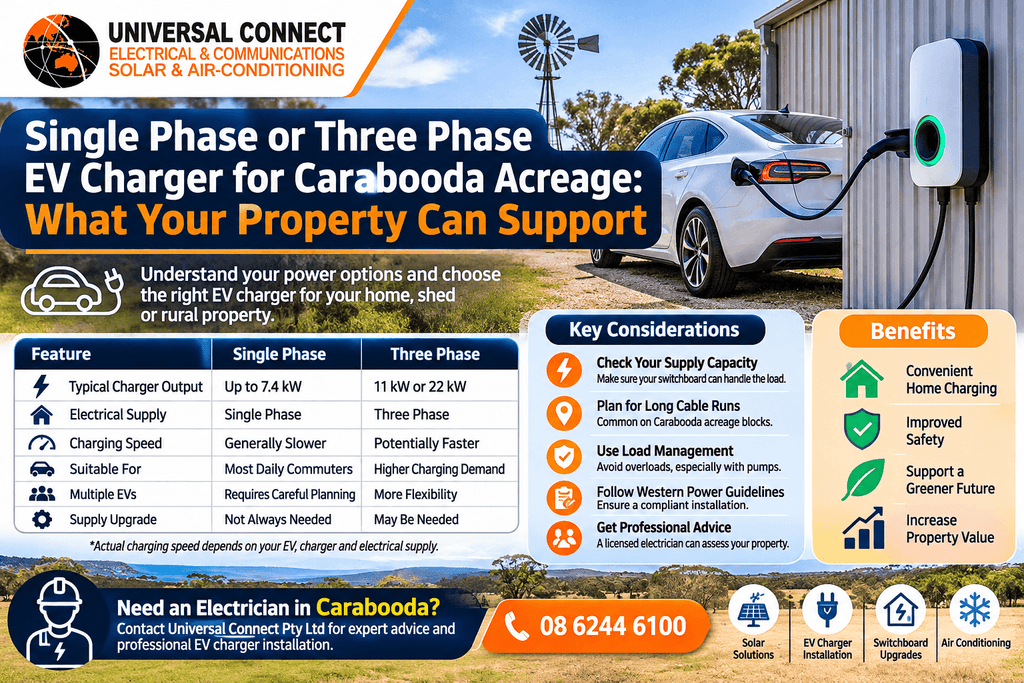
Every EV charger needs its own dedicated circuit with the right protection, including a safety switch suited to EV charging. Older rural switchboards often have no spare space, old protection devices, or signs of heat damage. An upgrade may be needed before the charger goes in.
On acreage, the car often lives in a shed or carport far from the main switchboard. Long cable runs cause voltage drop, which means the cable must be sized up to deliver the right power safely. Sometimes the shed already has a sub-board, and we check whether its submain can handle the extra load.
Western Power manages the network in Carabooda. It has rules about connecting EV chargers and about supply upgrades. Some installations need notification before or after work, and a change from single-phase to three-phase needs an application and approval. A licensed electrical contractor handles this paperwork and knows what applies to your property.
Many owners assume the only choice is “small charger” or “expensive supply upgrade”. Load management offers a third option.
A load management system monitors how much power your property uses in real time. When the house draws heavily, such as the bore pump running with the air conditioner on, it slows the charger down. When demand drops, it speeds charging back up.
This approach lets many properties run a larger charger without upgrading the supply. It also prevents nuisance tripping, which is a common complaint on acreage blocks with pumps.
If you have solar panels, some chargers can also prioritise charging from excess solar during the day. For owners who work from home or have a second car parked during daylight, this can make good use of your own generation.
Some Carabooda properties are not just homes. They run market gardens, small farm stalls, equipment hire or trade businesses from the shed.
In these cases, we often apply a commercial electrician mindset:
Experienced electrical contractors Carabooda landholders work with will ask about your property’s full use, not just the car in front of them.
The commuter couple. A couple on a five-acre block each drive about 80 kilometres a day. Their property has single-phase supply. One EV accepts 7 kW AC charging. We installed a single-phase charger with load management. The car fills up overnight, and the bore pump no longer trips the main switch.
The workshop owner. A tradesperson already has three-phase supply for his workshop. His EV ute accepts 11 kW. A three-phase charger fitted to the existing shed sub-board after a capacity check, with no supply upgrade needed.
The two-EV family. A family plans to replace both cars with EVs within two years. Their single-phase supply already runs close to its limit. We discussed a three-phase upgrade through Western Power, plus a switchboard upgrade, so both cars can charge overnight without problems.
The single-phase vs three-phase EV charger Carabooda choice depends on three things: what your car can accept, what your property’s supply can handle, and how you plan to use EVs over the next few years. For many households, single-phase with load management works well. For multi-EV families, workshops and rural businesses, three-phase often makes more sense.
Universal Connect Pty Ltd is a licensed electrical contractor (EC13414) based in Perth’s northern suburbs. We provide switchboard upgrades, surge protection and EV charger installation for homes and acreage properties.
If you need an electrician Carabooda owners trust, or a residential electrician Carabooda families can call for a clear assessment, talk to our team. We will check your supply, your switchboard and your car’s needs, then recommend a charger that suits your property.
No. Most EV owners charge comfortably on a single-phase charger of around 7 kW. This adds enough range overnight for typical daily driving. Three-phase charging helps if you drive long distances, run more than one EV, or already have three-phase supply. An electrician Carabooda owners use can check your car’s charging rating and daily driving needs, then recommend the option that suits your property without overspending on hardware.
Often, yes, but it needs careful planning. Bore pumps, irrigation, air conditioning, and an EV charger all draw from the same supply capacity. On hot evenings, they can overload the supply and trip your main switch. Load management solves this by slowing the charger when other demand is high. A residential electrician Carabooda homeowners hire should check your total load before installing any charger, especially on properties with pumps.
It depends on Western Power’s process and the network near your property. The upgrade requires an application, approval, and often changes to the meter, service cable and switchboard. Some properties move quickly, while others need network work first. Experienced electrical contractors Carabooda landholders hire will lodge the application and explain the expected steps. We always suggest checking this early if you plan to buy a second EV or expand a business.
Your car’s onboard charger sets the limit. For example, many EVs accept a maximum of 11 kW on three-phase AC charging, even if the wall charger offers 22 kW. Some models accept only around 7 kW. Charging also slows as the battery gets close to full and in extreme heat. Always check your vehicle’s AC charging rating before choosing a charger, so you do not pay for capacity your car cannot use.
Load management monitors your property’s total power use in real time. When other appliances draw heavily, it reduces the charging rate so the supply does not overload. When demand drops, charging speeds back up. This lets many properties install a capable charger without a supply upgrade. On acreage with bore pumps and workshops, it also prevents nuisance tripping. Some systems can also prioritise charging from your solar panels during the day.