
A tenant calls on a Monday morning. Half the lights in the shop are out, the air conditioner is blowing warm air, and the EFTPOS machine keeps dropping offline. Customers are already at the door.
If you own or manage a small commercial property, you have probably had a call like this. Small shops, offices, clinics and light industrial units rarely have an on-site maintenance team. When something breaks, the owner or property manager has to find the right trade, fast.
That is where small commercial property building services come in. In this guide, our team at Universal Connect Pty Ltd explains what building services actually cover, who looks after what, and how a good maintenance plan prevents most of those Monday morning calls. As an electrical contracting company working across Perth, we see the same problems again and again, and most of them are avoidable.
Building services are the systems that make a building safe, comfortable and usable. Walls and roofs give you a shell. Building services make that shell work.
For a small commercial property, building services usually include:
Big office towers have facilities managers to coordinate all of this. Small property owners usually do it themselves, often between other jobs.
Responsibility often causes confusion in small commercial buildings. The lease usually decides who pays for what, but here is how it commonly works in practice.
The owner usually looks after the base building. This includes the main switchboard, the incoming supply, common area lighting, and any shared air conditioning plant.
The tenant often looks after items installed for their own business. This can include their own fit-out lighting, extra power points, data cabling and equipment.
The contractor carries out the work, tests it and provides the paperwork. A reliable contractor also tells you clearly when an issue belongs to the owner or the tenant, so nobody pays for the wrong thing.
Always check your lease. If it is unclear, ask your contractor to describe each fault clearly in writing. A clear report helps owners and tenants settle questions quickly and fairly.
Electrical work sits at the centre of every small commercial building. An experienced electrical contractor typically handles:
Even well-maintained buildings have faults. Common electrical repair jobs we see in small commercial properties include:
Air conditioning and network cabling are closely tied to electrical work. Each air conditioner needs a dedicated circuit and an outdoor isolator. Each data cabinet needs reliable power and, ideally, surge protection.
Universal Connect Pty Ltd provides electrical, air conditioning and network cabling services. This means one team can plan the power, cooling and data for a tenancy together, instead of three separate trades working around each other.
Most expensive breakdowns start as small problems nobody noticed. A simple maintenance schedule catches them early. Here is a practical approach for small commercial properties.
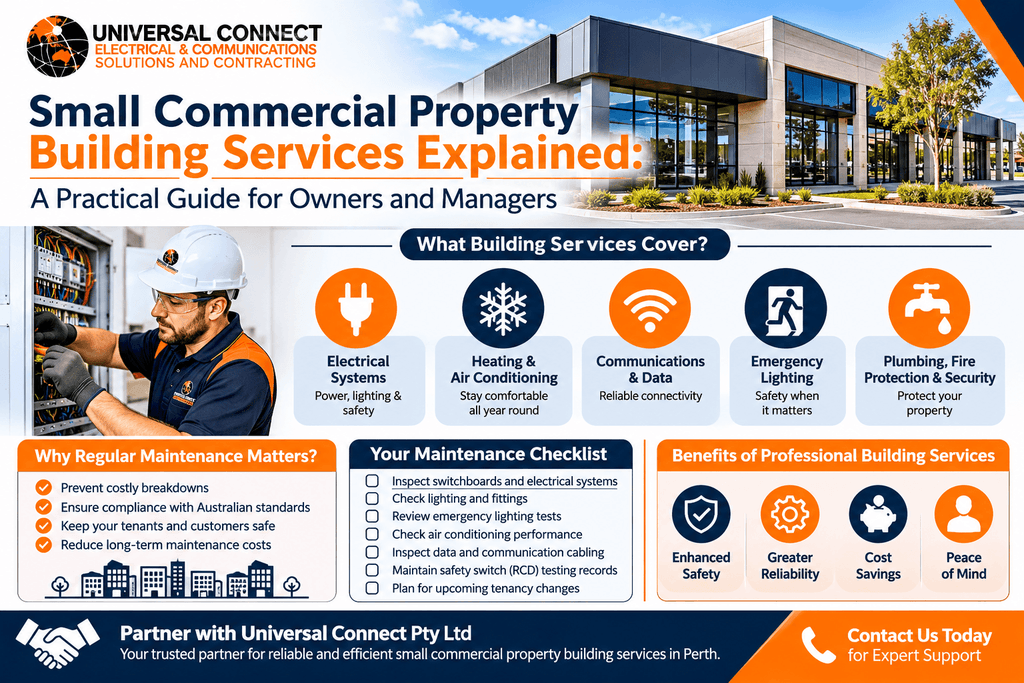
Good facilities maintenance services follow a written schedule like this and keep clear records. Those records help with insurance, audits and lease disputes.
The café fit-out. A new café takes over a former clothing shop. The tenancy needs dedicated circuits for coffee machines, fridges and a dishwasher, plus extra lighting and data for the POS system. Planning all of it before the fit-out starts avoids rework and delays to opening day.
The small medical suite. A physiotherapy clinic needs reliable power, good lighting, data points in every treatment room, and quiet air conditioning. One coordinated plan keeps all these systems working together.
The light industrial unit. A small manufacturer moves into a warehouse unit. They need three-phase power for machinery, high-bay LED lighting, and a safe switchboard layout. Checking supply capacity early prevents surprises after the machines arrive.
In each case, using a single contractor for electrical, air conditioning, and data made coordination simpler for the owner and tenant.
Small commercial property building services are not just about fixing things when they break. They cover planning, regular maintenance, safe repairs, and clear records. Owners who treat them as an ongoing plan, not a series of emergencies, spend less and keep tenants longer.
Universal Connect Pty Ltd is a licensed electrical contracting company (EC13414) based in Perth’s northern suburbs. We provide electrical, air conditioning and network cabling work for small commercial properties, from routine maintenance to emergency callouts.
If you are looking for a building services contractor who can handle power, cooling and data under one plan, talk to our team. We are happy to look at your property and suggest a practical maintenance approach that suits your building and your tenants.
An electrical contracting company installs, maintains, and repairs the electrical systems in shops, offices, clinics, and small industrial units. This includes switchboards, lighting, power circuits, safety switches, surge protection, and emergency lighting. Many also handle air conditioning connections and data cabling. For small property owners, the biggest benefit is having one licensed team that understands the building, keeps records, and responds quickly when faults disrupt tenants or customers.
Most small commercial buildings benefit from checks every six months and a fuller inspection once a year. Emergency and exit lights need regular testing, and air conditioner filters need regular cleaning. Switchboards and safety switches should be inspected at least once a year. Good facilities maintenance services also include a full electrical check between tenants. The right schedule depends on your building’s age, use, and equipment, so ask your contractor to tailor one.
Using a single contractor for related systems, such as electrical, air conditioning, and data, often makes life easier. One team builds knowledge of your building, keeps consistent records, and plans work so systems do not clash. You still need specialists for plumbing and fire protection. A trustworthy building services contractor will tell you clearly which work falls within its licence and when you need another qualified trade.
Check the supply capacity, the switchboard space and the condition of the existing wiring. Find out what equipment the tenant plans to use, especially heavy loads like ovens, coffee machines, or machinery. Confirm who pays for what under the lease. Then get a written electrical plan before work starts. These steps prevent delays, avoid rework, and help the tenant open on time without surprises.
Keep electrical safety certificates, emergency lighting test results, safety switch test records, test and tag records, and service reports. Store them in a building logbook, either printed or digital. Insurers, auditors, and new tenants may ask for these documents. Good facilities maintenance services provide written reports after every visit, which makes record-keeping simple and shows that your building meets its safety obligations.