
Choosing a reliable electrician Perth homeowners and businesses can trust is an important step when maintaining a safe and functional electrical system. One area that often needs attention is the electrical switchboard, particularly in older properties where outdated components, limited circuit capacity or insufficient electrical protection may create problems. A properly assessed switchboard helps distribute electricity safely and supports the electrical requirements of modern appliances and equipment.
Many Perth properties were built when household electricity consumption was considerably lower than it is today. Modern homes now rely on air conditioning, induction cooktops, washing machines, entertainment systems, solar installations and electric vehicle chargers. These additional requirements can make an older electrical installation unsuitable for current use.
Understanding the switchboard upgrade cost factors perth property owners should consider is essential before arranging electrical improvements. From circuit breakers and safety switches to meter box conditions and existing wiring, several technical factors influence the work involved.
Universal Connect Pty Ltd recognises the importance of informed electrical planning. This guide explains the main considerations involved in switchboard upgrades, common electrical problems, modern protection systems and practical steps for preparing your property.
An electrical switchboard is responsible for distributing electricity from the incoming supply to different circuits throughout a property.
It also contains protective equipment designed to disconnect electrical supply when certain electrical faults occur.
A modern switchboard may contain:
Each component has a specific function.
For example, circuit breakers protect electrical wiring against excessive current caused by overloads and short circuits. Safety switches detect residual-current imbalances that may indicate electricity is flowing through an unintended path.
An outdated switchboard may not provide the protection or flexibility required for a property’s current electrical installation.
Consider a Perth home built 25 years ago.
When it was constructed, its electrical requirements may have included basic lighting, general power outlets, a refrigerator and standard kitchen appliances.
Today, the same home may have:
These additions can change the property’s electrical demand.
A licensed electrician should assess whether the existing switchboard, incoming supply and circuit arrangements remain suitable.
Not every switchboard requires the same improvements. The amount of work depends on the installation’s condition, electrical requirements and safety considerations.
Here are eight important factors that can influence the scope of a switchboard upgrade.
The existing switchboard is the starting point for any upgrade assessment.
Older properties may contain rewirable fuses, outdated electrical components or enclosures that have deteriorated over time.
An electrician should inspect:
For example, a property with an old ceramic fuse system may require different work from a home with an existing circuit breaker switchboard.
The electrician should identify which components are unsuitable and whether any existing equipment can safely remain.
Replacing the entire switchboard without assessing its condition may result in unnecessary work. Equally, retaining damaged components simply to reduce the scope of an upgrade is not an appropriate approach.
The number of electrical circuits connected to a switchboard affects the equipment and installation requirements.
Different circuits supply electricity to different parts of a property.
Common examples include:
A larger property may require more circuits than a small residential home.
For example, a house with a workshop, swimming pool, ducted air conditioning and multiple kitchen appliances may have a more complex electrical arrangement.
During an upgrade, an electrician may identify the need to separate certain loads or provide additional circuits.
However, adding circuit breakers does not automatically increase the electricity supply available to a property. Incoming supply capacity and electrical load requirements must also be considered.
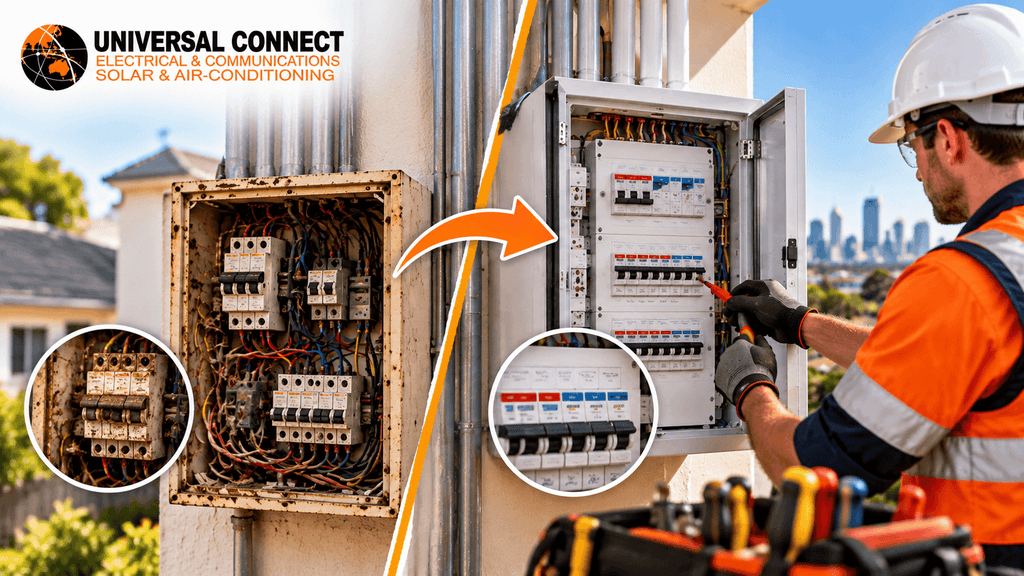
Circuit breakers are essential for protecting electrical circuits.
They automatically interrupt the electrical supply when current exceeds an appropriate level because of an overload or short circuit.
Selecting the correct circuit breaker involves considering:
An unsuitable circuit breaker can compromise electrical safety.
For example, if a circuit repeatedly trips, replacing its breaker with a higher-rated device without investigating the underlying problem is not a suitable solution.
The issue may involve an overloaded circuit, damaged wiring or a faulty appliance.
A qualified electrician should identify the cause before recommending changes.
Safety switches and RCBOs are important components of modern electrical protection systems.
Although both provide residual-current protection, their arrangements and functions differ.
Safety switches (RCDs)
An RCD monitors the electrical current flowing through a circuit. When it detects an imbalance that may indicate leakage current, it disconnects the supply.
This helps reduce the risk of electric shock.
RCBOs
An RCBO combines residual-current protection with overcurrent protection.
This means it provides the functions of an RCD and a circuit breaker in one device.
One practical benefit of individual RCBO protection is circuit separation.
For example, if a fault occurs on one circuit protected by an individual RCBO, other circuits with separate protection may continue operating.
By comparison, multiple circuits protected by a shared RCD arrangement may lose power together when that RCD trips.
The most suitable arrangement depends on the electrical design, installation requirements and equipment compatibility.
The meter box and switchboard enclosure should be assessed before an upgrade begins.
Older installations may have damaged covers, limited space or unsuitable mounting arrangements.
An electrician may identify:
If the existing enclosure is unsuitable, replacement or modification may be necessary.
It is also important to understand that a meter and a switchboard are not necessarily the same component. Metering equipment may have separate ownership and access requirements.
Any work involving the electricity meter should be coordinated with the appropriate metering provider or network operator.
Asbestos is a significant consideration when working on some older properties.
Certain electrical meter boxes and switchboards may contain asbestos-containing backing boards.
These materials were historically used as mounting surfaces for electrical equipment.
The presence of asbestos cannot reliably be confirmed through visual inspection alone.
If an electrician suspects an asbestos board, it should not be disturbed until appropriate assessment and safety arrangements are in place.
Depending on the material and project requirements, the work may involve:
In Western Australia, a licensed asbestos removalist is required for any amount of friable asbestos and more than 10 square metres of non-friable asbestos removal.
Property owners should confirm who will manage asbestos-related work and ensure the relevant qualifications and licensing requirements are met.
Important: Never drill, cut, sand or break a suspected asbestos panel. Arrange appropriate professional assessment before any disturbance.
An electrical switchboard upgrade may reveal problems elsewhere in the installation.
For example, an electrician may identify deteriorated cable insulation, loose connections or inadequate earthing arrangements.
Other issues can include:
Consider a property where the power repeatedly trips when several kitchen appliances are operating.
The cause may be an overloaded circuit, a faulty appliance or a wiring problem.
Simply replacing the switchboard will not necessarily resolve the issue.
The electrician should investigate the fault and identify the appropriate corrective work.
This is particularly important when upgrading older properties because existing electrical problems may not be visible from outside the switchboard.
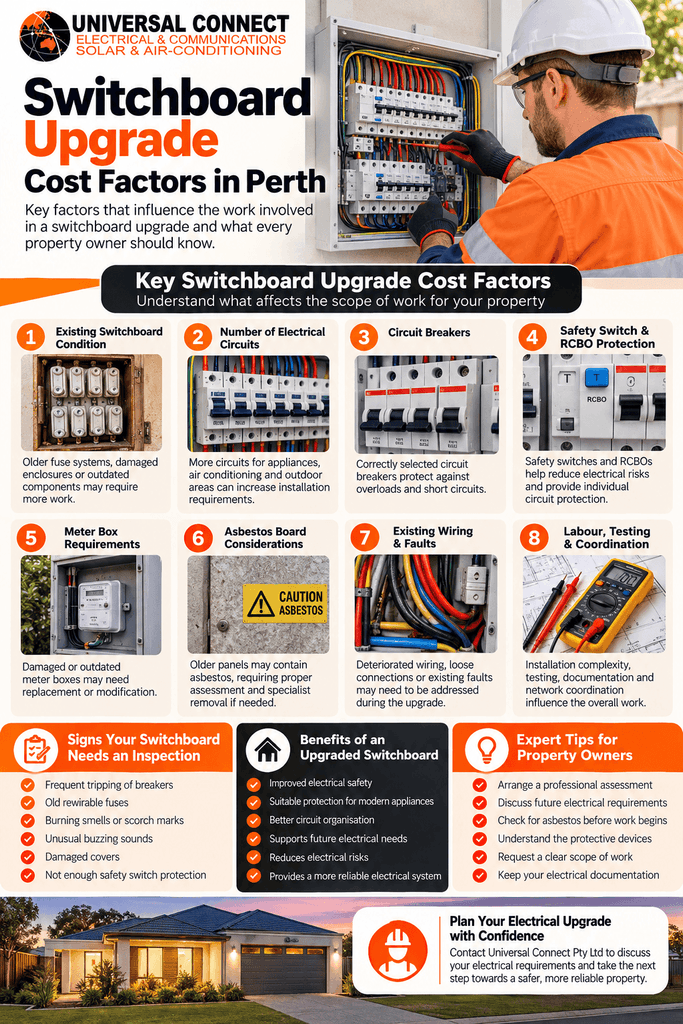
The complexity of the installation also influences the amount of work involved.
A straightforward replacement may require fewer installation activities than a project involving additional circuits, enclosure replacement or electrical fault repairs.
The installation process may include:
Some projects may require additional coordination with electricity network operators or metering providers.
Commercial installations may also require careful scheduling to minimise disruption to business activities.
Testing and documentation are important parts of completing electrical installing work.
Selecting an electrical contractor requires careful consideration.
A suitable contractor should understand the installation requirements, explain the proposed work and ensure that electrical work is undertaken by appropriately licensed personnel.
When comparing electrical contractors perth, consider the following factors.
Electrical installing work in Western Australia must be undertaken by appropriately licensed electrical workers and contractors.
Before proceeding, verify the relevant licences and confirm that the proposed work falls within the contractor’s authorised scope.
Where specialist services are required, such as asbestos removal, confirm that the responsible provider has the necessary qualifications and licences.
A clear quotation should explain the work being recommended.
Ask whether it includes:
This makes it easier to understand the scope and avoid misunderstandings.
Different electrical installations require different protective devices.
Ask the electrician why particular circuit breakers, RCDs or RCBOs are being recommended.
The explanation should be based on your property’s electrical requirements rather than a standard arrangement applied to every property.
Existing faults may become apparent during an upgrade.
Ask how additional work will be explained, documented and approved.
This is particularly important when dealing with older properties that may have deteriorated wiring or suspected asbestos-containing materials.
Modern buildings use electricity in more ways than older properties.
As homes and commercial premises are renovated, extended or fitted with additional equipment, their electrical requirements can change.
This is why electrical services Perth property owners require should be considered in relation to the property’s current and future needs.
Kitchen renovations, home extensions and outdoor improvements can introduce additional electrical loads.
For example, a kitchen renovation may require dedicated circuits for an oven, induction cooktop and other appliances.
Before adding new electrical equipment, the existing switchboard and supply capacity should be assessed.
Solar panels and battery storage introduce additional electrical equipment and protection requirements.
The existing switchboard may need modifications to accommodate the proposed installation.
An electrician should assess equipment compatibility, circuit arrangements and applicable connection requirements before work begins.
Electric vehicle chargers can place additional demand on a property’s electrical supply.
Before installation, the electrician should assess:
This helps determine whether the existing installation can support the proposed equipment.
Commercial premises may have refrigeration systems, machinery, air conditioning and other high-demand equipment.
These systems need suitable circuit arrangements and electrical protection.
For example, a business operating commercial refrigeration may need careful planning before electrical work begins to avoid unnecessary disruption.
Switchboard problems are not always immediately obvious.
However, certain warning signs should be taken seriously.
Look for:
If you notice smoke, burning smells or visible heat damage, keep clear of the switchboard and seek urgent professional assistance.
Never remove switchboard covers or attempt to repair electrical components yourself.
A licensed electrician can investigate the problem and determine whether repair, component replacement or a complete upgrade is necessary.
Planning an electrical upgrade without understanding the existing installation can create unnecessary complications.
Here are some mistakes property owners should avoid.
Repeated tripping is a warning that something may be wrong with an electrical circuit or connected appliance.
Do not repeatedly reset a protective device without investigating the cause.
Not all circuit breakers and protective devices are interchangeable.
The selected equipment must be suitable for the switchboard and electrical installation.
If you are planning solar, battery storage or EV charging, discuss these requirements before finalising the switchboard design.
Suspected asbestos-containing materials must be assessed before disturbance.
Incorrect handling can expose workers and occupants to harmful asbestos fibres.
Keep the quotation, installation records and applicable electrical safety certificate after the work is completed.
In Western Australia, an electrical safety certificate is generally required within 28 days of completing electrical installing work, subject to applicable exemptions.
These records can be useful for future electrical maintenance and property management.
A properly planned upgrade starts with understanding the property’s actual electrical requirements.
The following practical recommendations can help.
Arrange an on-site inspection: An electrician can assess the existing installation and identify work that may be required.
Explain existing electrical problems: Mention repeated tripping, damaged components, unusual sounds or other concerns.
Discuss future electrical equipment: Explain any planned renovations, solar systems, battery storage or EV charging installations.
Understand the protection arrangement: Ask how circuit breakers, safety switches and RCBOs will be used.
Identify asbestos concerns early: Older electrical panels should be assessed before any suspected asbestos material is disturbed.
Request a detailed scope: Make sure the proposed equipment, installation activities and testing requirements are clearly explained.
Retain completion documents: Keep all relevant electrical safety records for future reference.
Electrical work should be planned around the condition and requirements of each individual property.
Universal Connect Pty Ltd is the brand featured in this guide. Property owners should understand the proposed electrical work before making decisions about their switchboard.
Important matters to discuss during an electrical assessment include:
A suitable upgrade should address the property’s electrical requirements while following applicable safety and compliance requirements.
If you are considering electrical improvements, contact Universal Connect Pty Ltd to discuss your requirements and the appropriate next steps.
Planning an electrical upgrade requires an understanding of the existing installation, electrical protection and the property’s future requirements. Choosing an appropriately licensed electrician Perth property owners can consult is an important step towards making informed decisions about electrical safety.
The switchboard upgrade cost factors perth homeowners and businesses should understand include the existing switchboard condition, number of circuits, circuit breakers, safety switch protection, RCBO selection, meter box requirements, asbestos concerns and additional wiring work.
When comparing electrical contractors perth, consider their licensing, proposed installation scope, equipment selection, testing procedures and documentation. Similarly, selecting suitable electrical services perth providers involves understanding whether the recommended work matches your property’s actual requirements.
Universal Connect Pty Ltd encourages property owners to approach switchboard improvements with proper planning and professional electrical assessment. A carefully considered installation can support the safe and reliable operation of your property’s electrical system.
Before arranging an upgrade, consider the condition of the existing enclosure, circuit arrangements, protective devices and electrical wiring.
An electrician should also assess whether the incoming supply is suitable for the property’s current requirements.
If the property is older, check whether suspected asbestos-containing materials are present before any disturbance.
A proper inspection helps establish whether a complete replacement or selected improvements are appropriate.
RCBOs combine residual-current protection and overcurrent protection in one device.
They can help protect individual circuits against certain electrical faults.
For example, separate RCBOs may allow a fault on one circuit to be isolated without interrupting other independently protected circuits.
The correct selection depends on the electrical installation, circuit requirements and applicable standards.
Yes, an existing meter box may be retained if its condition, design and available space are suitable for the proposed work.
However, a damaged enclosure, unsuitable mounting arrangement or insufficient equipment space may require replacement.
An electrician should inspect the meter box before confirming the upgrade scope.
Avoid disturbing the material.
Do not drill, cut, sand or attempt to remove it yourself.
Arrange appropriate professional assessment and follow the applicable Western Australian asbestos safety requirements.
Where removal is necessary, ensure the work is handled by a suitably qualified and licensed asbestos removalist when required.
Check the contractor’s relevant Western Australian electrical licence and ask about their experience with the type of installation involved.
Review the proposed equipment, circuit protection, installation scope, testing procedures and completion documentation.
You should also clarify how additional faults or asbestos concerns will be managed.
A contractor who clearly explains the proposed work makes it easier to understand the installation and make an informed decision.