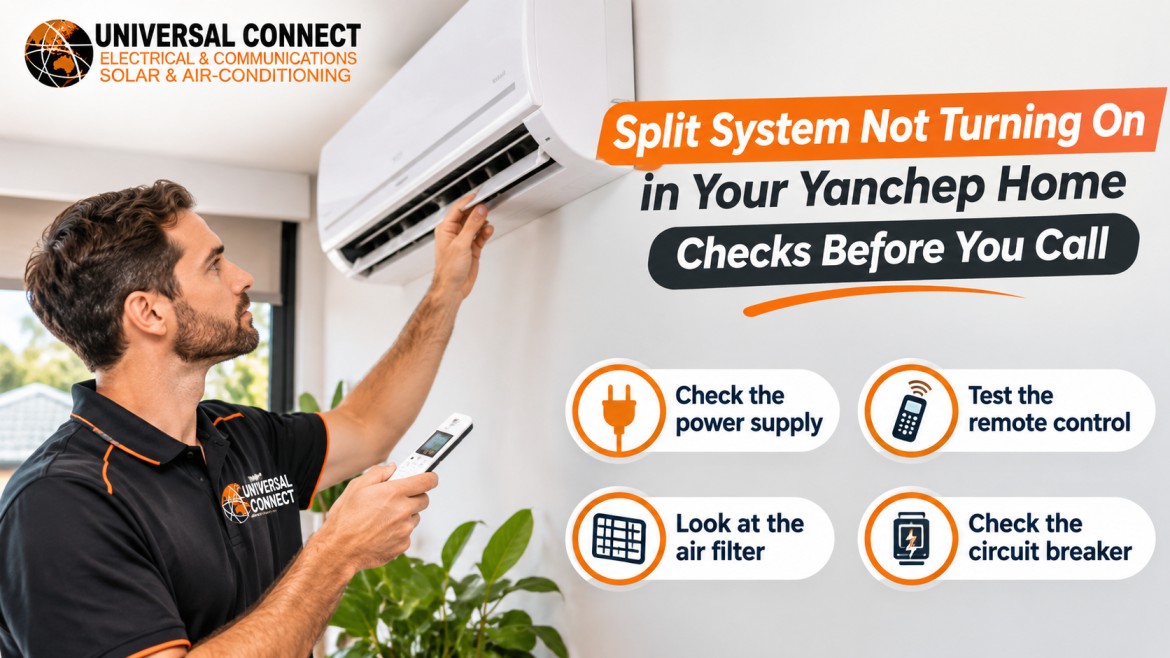
It is the first hot weekend of summer. You press the button on the remote, wait for the familiar beep and get nothing. No lights, no fan, no cool air. The house is warming up fast, and you start wondering if the whole unit has died.
Before you panic, take a breath. In our experience, a split system not turning on yanchep homeowners report is often caused by something simple. A flat battery, a tripped breaker or an isolator switched off by mistake explains a surprising number of call-outs.
This guide walks you through the safe checks you can do yourself, in the order we use on site. It also shows the warning signs that mean you should stop and call a licensed electrician yanchep families trust. Some faults are quick fixes. Others need a professional, and knowing the difference keeps you safe.
A split system has two parts. The indoor unit sits on your wall, and the outdoor unit sits outside with the compressor. Power usually comes from a circuit at your switchboard, and an isolator switch near the outdoor unit lets technicians cut the power safely.
If any link in that chain fails, the unit will not start. The problem can sit in the remote, the power supply, the safety devices or the unit itself.
Yanchep adds its own challenges. Coastal salt air corrodes outdoor fittings faster than in inland suburbs. Strong summer sun breaks down cheap plastic isolators. And sudden summer storms can cause brief outages that leave units in a protective lockout.
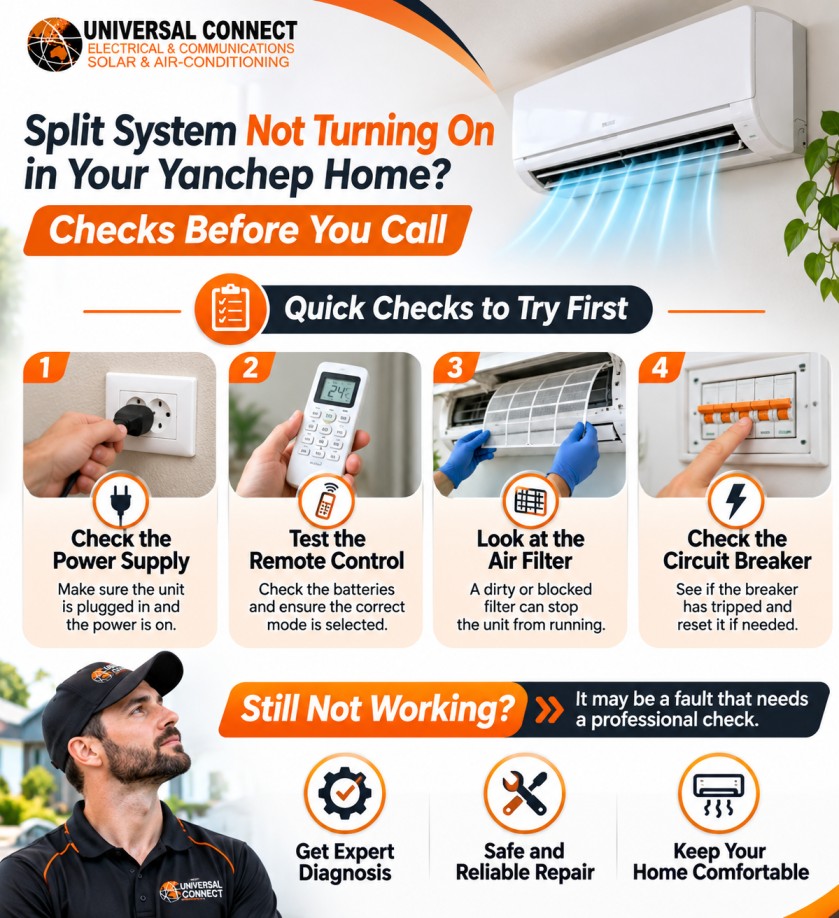
Start with the simplest part. The remote control causes more “dead” air conditioners than most people expect.
Swap in fresh batteries, even if the screen still shows numbers. A weak battery can light the display but fail to send a strong signal.
Next, check the mode. If the remote is set to fan, dry or a high temperature, the unit may run quietly or not seem to start at all. Set it to cool, drop the temperature a few degrees and press power again. Also check that no timer or child lock is active.
Most split systems have a small manual or “forced” button on the indoor unit, often under the front panel. Pressing it starts the unit in auto mode. If the unit starts this way, the remote is the problem, not the air conditioner.
If the remote is fine, the next step is power.
Go to your switchboard and look for any circuit breaker or safety switch in the off or middle position. Many homes label the air conditioning circuit, but older boards may not.
If you find one tripped, switch it fully off, then back on once. If it holds, try the unit again. If it trips again straight away, leave it off. A breaker that keeps tripping is telling you there is a real fault, often moisture, a damaged cable or a failing component. Resetting it again and again can make the fault worse.
The isolator switch sits near the outdoor unit. Gardeners, painters and people pressure washing walls sometimes switch it off and forget to turn it back on. Check that it is in the on position.
While you are there, look at the isolator closely. In coastal suburbs like Yanchep, we often find isolators with cracked covers, faded plastic or water inside. Do not open or touch a damaged isolator. Note what you see and call a professional.
If the indoor unit shows flashing lights or a code on its display, it is trying to tell you something. Every brand uses different codes, so check your user manual or the brand’s website for the exact meaning.
Write down the fault code before you call anyone. It helps the technician bring the right parts and often saves a second visit. Common causes include sensor faults, communication errors between the indoor and outdoor units, and drain or float switch problems.
Also remember that many units have a built-in restart delay. After a power cut or a reset, the compressor may wait a few minutes before starting. This protects it from damage. Give the unit around five minutes before you assume it has failed.
When the simple checks do not work, the problem is usually electrical. These are the faults we see most often in local homes:
Here is a real example. A family near Yanchep Lagoon called us when their bedroom split system stopped working during a heatwave. They had reset the safety switch three times, and it kept tripping. The team at Universal Connect found water inside a sun-damaged isolator on the outdoor unit. We replaced it with a sealed, UV-stable model and tested the circuit. The unit was running within the hour. This is the kind of fault a licensed residential electrician yanchep families call can find and fix safely.
Stop all checks and call a licensed electrician straight away if you notice:
Never open the indoor or outdoor unit yourself. Refrigerant work needs an ARCtick licence, and electrical work in WA needs a licensed electrician. DIY repairs can void your warranty and put your family at risk.
Most split system failures give warning signs. Regular checks catch them early.
Reliable electrical services yanchep homeowners use will check both the air conditioner circuit and the isolator, not just the unit itself.
These mistakes turn small faults into bigger repairs:
Experienced electrical services yanchep providers will tell you honestly whether repair or replacement makes more sense.
A split system not turning on yanchep residents face often comes down to the remote, a tripped breaker or the isolator. Work through these checks in order, note any fault code, and stop at the first sign of heat, burning or repeated tripping.
When the simple checks do not solve it, a qualified residential electrician yanchep homeowners trust can find the fault quickly and safely.
If your unit is still not working, talk to a licensed electrician yanchep families recommend. The team at Universal Connect is happy to check your circuit, isolator and connections, and get your home cool again as quickly as possible.
The most common causes are a flat remote battery, a remote set to the wrong mode, an isolator switched off at the outdoor unit, or a tripped breaker on the air conditioning circuit. The rest of your home can have power while the air conditioning circuit is off. Check the remote, then the switchboard, then the isolator. If all three look fine and the unit still will not start, call a licensed electrician.
It is safe to reset it once, as long as there is no burning smell, scorching or water near the switchboard. Switch it fully off, then back on. If it holds, try the unit again. If it trips again, leave it off and call a licensed electrician yanchep homeowners trust. Repeated tripping means there is a real fault, such as moisture, a damaged cable or a failing part.
Most units show a code on the indoor display, or flash the operation and timer lights in a pattern. Some brands let you check the code by pressing a button on the remote. Your user manual or the brand’s website lists what each code means. Write the code down before calling, because it helps the technician diagnose the problem faster and bring the right parts on the first visit.
There is no fixed timeline, but in coastal suburbs like Yanchep, isolators often wear out faster because of salt air and strong sun. Check yours each spring. If the cover is cracked, faded, loose or shows any moisture inside, replace it. A licensed residential electrician yanchep families rely on can fit a sealed, UV-stable isolator that lasts much longer in harsh conditions and keeps your unit safe.
Always rule out the electrical side first. Many units that seem dead only need a new isolator, a fixed connection or a reset after a fault. If the unit is more than ten to fifteen years old, uses outdated refrigerant or needs a major part such as a compressor, replacement may make more sense. Good electrical services yanchep providers will test the circuit and give you an honest answer before you spend money.